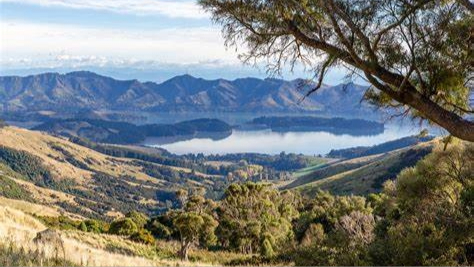
A new pest free strategy will build on past experience to deliver future biodiversity gains and help nature thrive across Banks Peninsula and beyond.
“Since we set the first trap in 2022, we’ve been collecting all sorts of data – from ground experience from our rangers, our surveillance camera network, scent detections from our detection dogs, and community reporting,” said Pest Free Banks Peninsula Project Lead, Brett Butland. “We’ve built the capability to innovate and to solve complex problems at scale, and we continue to learn how to achieve elimination outcomes quicker and cheaper. We’re now able to use this knowledge to extend our impact, both on biodiversity and by contributing our experiences to conservation practices around New Zealand.”
Pest Free Banks Peninsula (PFBP) released its updated strategy last week – described as feasibly ambitious. It heralds a new direction for some projects, expands their operations beyond the peninsula to natural barriers and seeks to protect the gains already made.
“We’re doing this because we have the practical tools and knowledge to achieve it, but also because we want to meet the expectations of the communities and landowners we work with. They have observed and supported our work, particularly around Akaroa, and they’re keenly awaiting ‘their turn’. There is everything to be gained by continuing to work at pace and delivering to our communities’ expectations.”
The strategy will deliver ‘transformational impact’ including prioritising defence efforts in areas where PFBP has achieved elimination of possums, ferrets, hedgehogs, feral goats and feral pigs. Possum elimination on the peninsula will extend, again based on the programme’s successful progress to date. New funding will be sought to enable this to happen at pace, with a new goal of eliminating possums, mustelids, feral cats and lagomorphs (rabbits and hares) by 2030 (rather than by 2050).
The end results, says Butland, include enhanced primary production values, increased recreational and tourism assets, and better ecological outcomes, including the translocation and reintroduction of species.
“The original strategy treated Banks Peninsula as a mainland 110,000 ha ‘island’ where we were seeking to systematically eliminate predators in staged phases, which would enable native species to recolonise large, connected areas rather than surviving in fragments.
What we’re attempting now is to create a massive ‘buffer zone’ around the peninsula, including a community-led ‘virtual barrier’ in the Whakaraupō catchment and Port Hills. We will establish a ‘proof of concept’ for multi-species elimination in the southern bays of Banks Peninsula and prepare to expand westward to eliminate pest animals from 850,000ha between the coast, Southern Alps and Rakaia and Waimakariri rivers under the Pest Free Waitaha umbrella.”
A summary of the PFBP project’s achievements to date:
- Elimination of possums from over 3,248ha in Akaroa and surrounding area (with elimination of possums from over 7,500ha forecast for 30 June 2026, eastwards of Long Bay Road)
- Elimination of feral goats south of Gebbies Pass (4200 removed from 45,000ha)
- Proof of concept for feral pig elimination (20,000ha)
- Elimination of ferrets from Kaitorete (with elimination of possums and hedgehogs forecast by 30 June 2026)
- Suppression of weasels and stoats on Kaitorete
- Development of an 80-day, 500ha possum elimination blueprint
- Shared knowledge to increase capacity of community groups, particularly in the Port Hills and Whakaraupō areas and Towards Pest Free Waitaha
- Developed an effective proof of absence monitoring framework
- Hosted nine PF2050 sister landscape projects and shared our knowledge widely with many others, including international invasive species management groups.